
Nobody has ever told me to do less.
Not in fifteen months of going in circles trying to make AI work. Not in years of running eight businesses. Not in a book, a course, a podcast, or a single well-meaning conversation with someone who could see I was carrying too much.
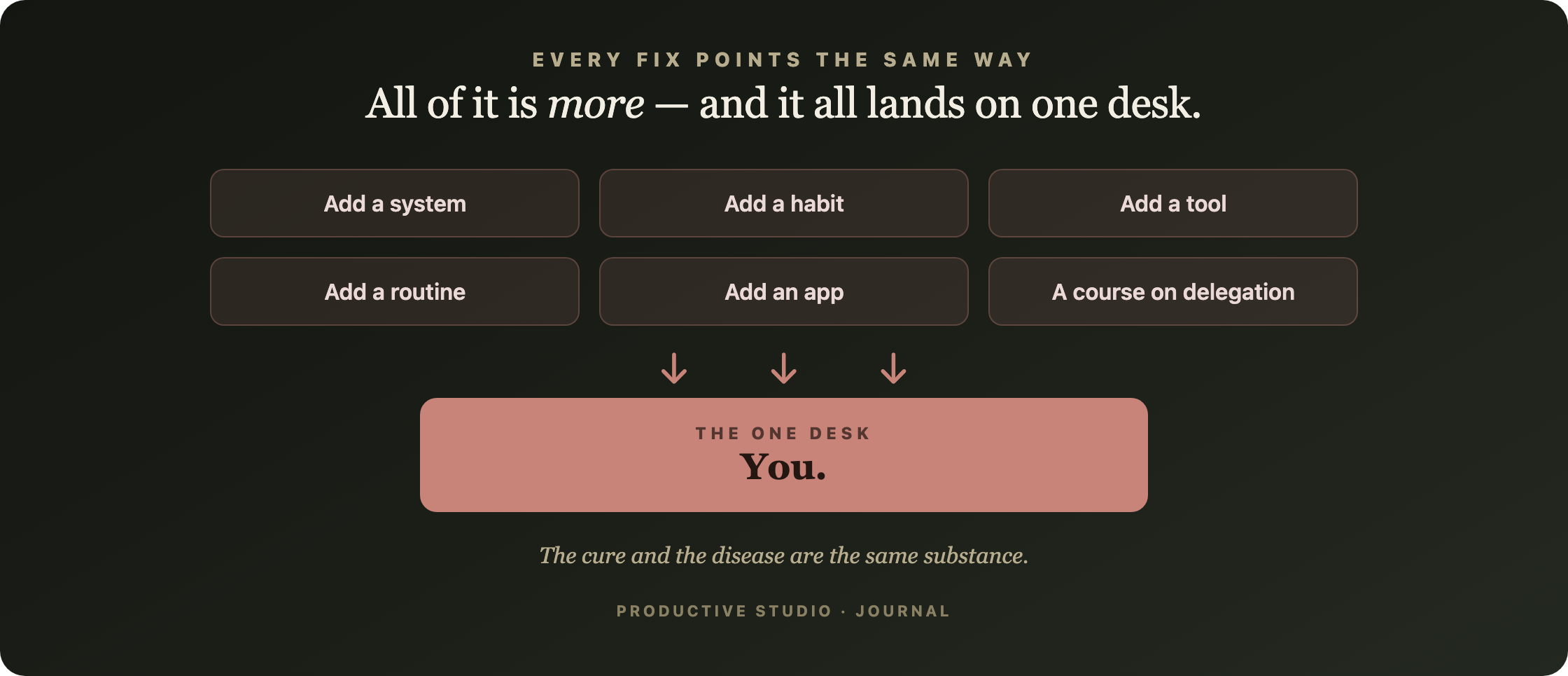
Every piece of advice I have ever been given pointed the same direction. Add a system. Add a habit. Add a tool. Add a morning routine, a batching method, a new app, a course on delegation, a better calendar.
All of it was addition. And all of it landed on the same desk.
Mine.
The catch-22
Here is the loop. I lived in it for years and I could not see the shape of it from the inside.
You’re overloaded. The accepted treatment for being overloaded is to do more — more planning, more systems, more discipline, more effort. So you do more. Doing more takes hours you don’t have, so you take them from the evening. Then from the weekend. Then from the part of the day you were supposed to be a person in.
Eventually you burn out. And what does burnout actually look like for a business owner? It doesn’t look like stopping. Nobody gets to stop. It looks like working around the clock, badly, on everything at once.
Which is more.
That’s the catch. The cure and the disease are the same substance. The loop can’t resolve, because every exit it offers leads directly back to the entrance. And the entire time you’re in it, it feels like effort. It feels like you’re doing the right thing. That’s what makes it so hard to see — you’re not being lazy, you’re not avoiding anything, you’re doing exactly what you were told. You’re just doing it in a direction that has no end.
I want to be specific about the feeling, because I think this is the part people recognise. It isn’t dramatic. It isn’t a breakdown. It’s the low, constant sense of being mildly behind, all day, forever — and the belief that one more push, one better system, one more early morning will finally get you level.
It never does. Because you didn’t get behind by not doing enough. You got behind because too many things require you.
Where the phrase came from
I want to tell this honestly and not make it into more than it was.
I was on the phone with my husband. We were talking about the business, the way we do. Not a strategy session. Not a planning meeting. A phone call.
And somewhere in it, one of us said the thing that had been sitting under the whole conversation without a name on it: it’s not about doing more. That’s what it feels like it should be. But that’s the thing that’s been going wrong.
I want to be accurate about what set that call off, because the honest answer is that nothing did.
There was no incident. No client blew up that week. No deal collapsed. Nothing arrived that either of us could point at and say that’s the thing. We were just both overwhelmed, and had been for a long time.
We’re partners in business as well as in life, which means we’ve taken a lot of risks together and tried a lot of things, and not all of them worked. That accumulates. Not as a crisis — as weight. By that point we were both feeling like we were drowning, and the question sitting underneath the whole call was the one we’d been circling for years without ever saying it in those words: what are we going to do? How do we get ahead?
I think the absence of a dramatic cause is the point. If there had been an incident, we’d have solved the incident, felt better for a fortnight, and carried on exactly as we were. There wasn’t one. This was just the ordinary condition — the thing it had become normal to feel — and you don’t fix normal with a better week.
Then it came out in one line.
Do less, not more, and get your time back.
That was it. There was no whiteboard. No brand strategist. No workshop where we distilled our values onto sticky notes. Two people who run businesses together, on a phone call, finally saying out loud the thing that neither of us had been able to say for years.
It became the tagline of this company later. But I want the order to be clear, because the order is the whole reason I trust it: the belief came first, out of a real conversation about a real problem, and the company got built to serve it. Not the other way around.
If it had come out of a branding exercise I wouldn’t repeat it. I’d be embarrassed by it. I repeat it because it’s the truest sentence I have about how I run things now.
What “less” does not mean
Let me clear out the obvious objection, because I had it too.
Less does not mean smaller. I did not scale back. I still run eight businesses. I did not lower a single standard, drop a client, or decide to be less ambitious. Nothing about my output went down.
Less does not mean lazy, and it does not mean minimalism, and it definitely does not mean “work four hours a week.” I don’t believe that and I’ve never seen it.
Less means fewer things that require you.
That’s the whole distinction. Not less work in the business. Less work that has to pass through the one bottleneck the business cannot replace. Your business will always have the same number of jobs in it. The question is how many of them are sitting on your desk because that’s genuinely where they belong, and how many are sitting there because that’s where they’ve always sat.
For years I never asked that question. Every task that arrived went to the same place by default, and the default was me.
The test
Here’s the question I ask now about anything that repeats.
Almost everything that used to eat my day was the second kind. Naming and filing something. Chasing an invoice. Checking whether a number moved. Turning an outline into a deck. Drafting a caption. None of that needed my judgment at the moment it happened. It needed my judgment once — about how it should be done, in what voice, to what standard — and after that it needed to happen consistently without me being awake for it.
I had confused those two things for my entire working life. I thought “I’m the only one who can do this properly” meant “I have to be the one doing it.” It doesn’t. It means I’m the only one who can define what properly means. That’s a much smaller job, and it’s a job you do once.
The work that genuinely needs a person stays with a person. Pricing. Positioning. What we build next. The client conversation that needs my actual face. Deciding what the business does. That’s the expensive skill in the room, and for years it got whatever was left of me at nine at night.
That’s the real cost of doing more. Not the hours. The fact that the hours went to the cheapest work in the building.
Why “do more” is the easiest advice in the world to give
I’ve thought about why this advice is so universal, and I think it’s because it can never be wrong.
If you do more and it works, the advice worked. If you do more and it doesn’t work, you clearly didn’t do enough of it. There’s no version where the advice is at fault. Every failure gets returned to you as a personal shortfall.
That’s why so many capable people end up convinced they’re the problem. They aren’t. I wrote a whole post about that — you’re not the problem, the order is — because the self-blame is so predictable that I can hear it coming before someone finishes the sentence.
Doing less is harder advice to give, because it requires you to actually change the structure of something. You have to build a place for the work to go. That takes a weekend of real setup instead of a motivational quote. But it ends, and doing more never ends.
What less actually looks like
I’m not going to pretend a phrase fixed my week. What fixed my week was building something that could hold the work I stopped holding.
The background layer of my business runs on operators now — one for content, one for research, one for files and admin, one for visuals, one for mapping processes. They have their own machine, their own memory, and their own scope. I set the standard once. They run against it whether or not I’m at my desk, and they remember what happened last week without me re-explaining it.
That’s the mechanism. It isn’t complicated and it isn’t magic. It’s just the difference between asking for help with tasks and handing over a function. I wrote about what it looked like when I gave my AI its own desk, because that’s where it started for me — with hardware, not with a better prompt.
And the two things doing less made possible are big enough that I gave them their own posts. One is that taking time off stopped being theoretical. The other is the part that actually matters, which is what you’re getting the time back for.
Because getting hours back is not the point. It’s just the first thing that has to happen.
What to do next
Don’t start by adding anything. Start by taking an honest inventory.
Write down every recurring thing you did last week. Then mark each one: does this need me, or does it need me to have decided once? Be strict about it. Most people find the majority of their week is the second kind, and that number should bother you in a useful way.
Then give away one of them. Properly — set up once, with memory, so it keeps running in three months instead of quietly dying in three weeks.
The AI COO Setup Kit is how I’d build that foundation. The dedicated environment, the memory that persists, the identity file that teaches your AI how your business actually runs — and then the operators that stand on top of it. It’s the fifteen months I spent going in circles, compressed into something you can follow in a day.
Do less. Not more. And then we’ll talk about what the time is for.
~ Elfina