
Almost everyone I talk to about bookkeeping has a drawer.
Sometimes it’s an actual drawer. Sometimes it’s a shoebox, a tote bag living in the back of a truck, a folder on a laptop called receipts full of screenshots. The container changes. The relationship to it doesn’t. It’s the thing you don’t open.
And here’s what I’ve noticed. When it comes up — at a dinner, in a DM, in the middle of a completely unrelated conversation about something else entirely — people lower their voice to tell me about it.
That’s the part I want to start with. Not the receipts. The voice drop.
A shoebox is a storage decision, not a system
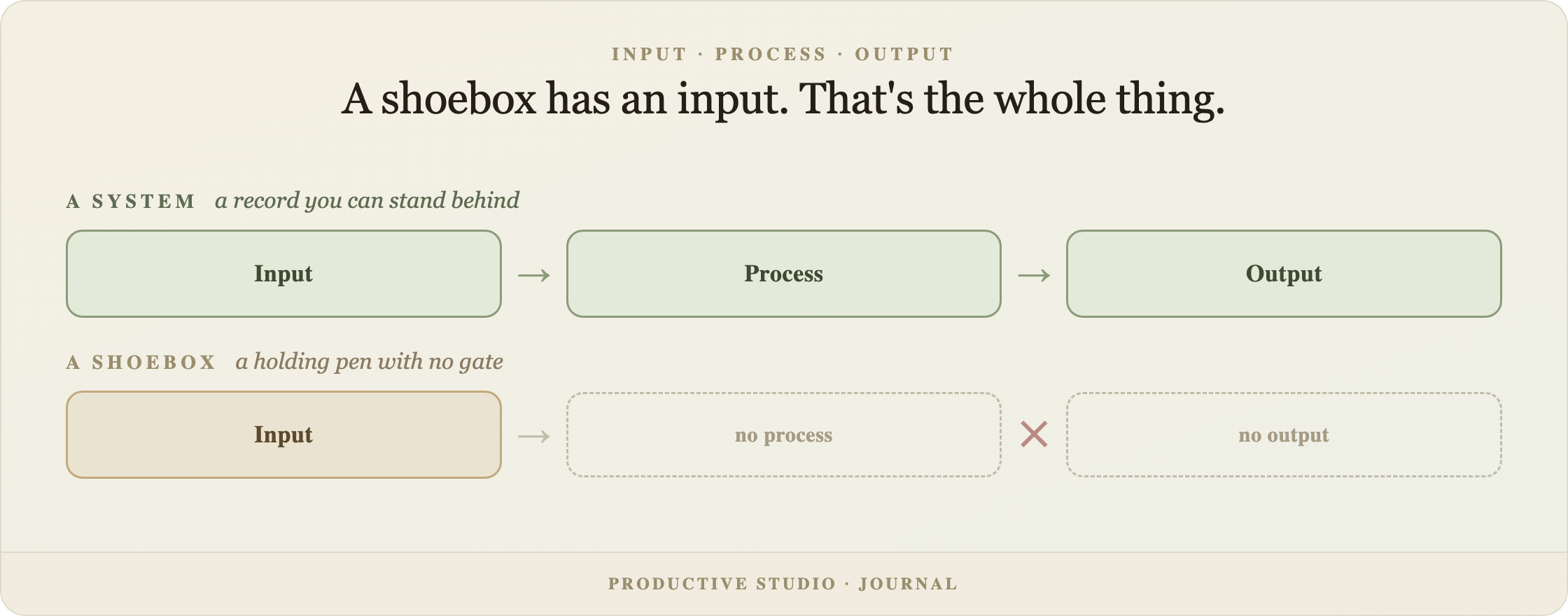
A system has an input, a process, and an output. Paper goes in, something happens to it, and what comes out the other side is a record you can stand behind.
A shoebox has an input.
That’s it. That’s the whole thing. It accepts. It never processes and it never outputs. Which means it isn’t failing at being a bookkeeping system — it was never running as one. It’s a holding pen with no gate at the far end.
I say this with total affection because I ran on shoeboxes for years across eight businesses. Twenty years in film, then home services, then equipment rental. Different industries, different scales, same grey lid.
And the reason I want to be precise about the shoebox not being a system is that most owners have quietly concluded the opposite. They think they have a system and they’re bad at it. They think the drawer is evidence of a personal failing — disorganized, undisciplined, not a real business person.
It isn’t evidence of any of that.
You can't be bad at operating a process that doesn't exist.
The part nobody says out loud
Here’s the thing that actually keeps the pile growing, and it has nothing to do with time.
It’s shame.
The pile gets past a certain size and you stop being able to hand it to anyone. You can’t give a bookkeeper a year of mixed paper — not because they’d refuse, but because you’d have to watch them receive it. You’d have to say the sentence out loud: this is all of it, this is what I’ve been doing.
So you don’t. You keep it. You tell yourself you’ll do a first pass before you hand it over, get it into some kind of shape, make it presentable. And that first pass never happens, because the first pass is the entire job.
I’ve watched people carry a backlog for years for exactly this reason. Not because they couldn’t afford help. Because the price of getting help was a moment of exposure they weren’t willing to pay.
Why the catch-up weekend doesn’t work
Every owner with a drawer has a plan for it. The plan is a weekend.
I’ve written elsewhere about what those afternoons actually did to me, so I won’t relitigate the misery here. What I want to point at is the structural reason the plan keeps not working, because it isn’t willpower.
The catch-up weekend depends on two things being true at once: you have a free block of hours, and you have the mental energy to spend them on your least favourite task. Those two conditions overlap rarely. And when they do overlap, something better is also available — which is how the weekend gets spent on literally anything else and the drawer rolls forward another quarter.
Worse, the paper doesn’t wait politely for the plan. Your busiest stretches generate the most receipts and leave you the least capacity to deal with them. So the pile grows fastest exactly when you’re least able to work it.
That’s a system that fails at peak load. Which is the one thing a system is not permitted to do.
Meanwhile the pile itself gets harder with age, not easier. Context evaporates. A receipt you can categorize instantly this week becomes a small mystery in four months, because the thing you were relying on was your memory of the day — and that’s the part with the shortest shelf life.
”Backlogs are my favorite food”
That’s Ledger’s line, not mine. I laughed the first time I read it back.
But it’s the correct instinct, and it took me a long time to understand why.
A backlog feels like the worst possible starting condition. It isn’t. A backlog is a complete set. Twelve months of paper is twelve months of evidence — every vendor you actually use, every category you actually spend in, every pattern in how your business really operates, all sitting in one place. Nothing has been thrown out yet. Nothing has been half-processed and forgotten.
Compare that to the person who’s been diligently filing a few receipts a week for a year. Their paper is scattered across a dozen decisions made on a dozen different days in a dozen different moods. There’s no single place to look.
The pile is dense, ugly, and complete. For software, dense and complete beats tidy and partial every time.
Which flips the thing you’re most ashamed of into the thing that’s most workable. The drawer isn’t the hard part of your books. The drawer is the easy part, because it’s the part where all the information still exists. The hard part is the transactions from three years ago where the paper is genuinely gone and nobody can reconstruct it.
You don’t have that problem.
You have a full drawer. That's a good problem.
The rule I learned the hard way
Now the unglamorous part.
The most expensive word in bookkeeping is missing. Because “missing” isn’t a note — it’s an action. It starts a chase. Somebody emails a vendor, somebody digs through an inbox, somebody goes hunting for a portal login they haven’t used since spring. Every false “missing” costs real attention.
Early on, running a live batch, Ledger reported receipts as missing that were not missing at all. They were sitting in a subfolder that had already been worked — including _PROCESSED-SOURCE-RECEIPTS, the folder where processed originals land. The top-level look was clean. The answer was one level down.
So the intake rule became absolute: walk every subfolder, including the processed ones, before declaring anything missing. No partial look counts. You do not get to say a document isn’t there until you’ve been everywhere it could be.
That sounds like a small technical detail. It isn’t. It’s the difference between a tool that reduces your workload and a tool that manufactures homework for you. A system that cries missing is worse than no system, because now you’re doing your books and chasing ghosts.
This is the kind of rule you only get from running real batches on real businesses and being wrong in public. It doesn’t come from a spec.
What I’d actually do with the drawer this week
Not a filing system. Please don’t buy envelopes.
Do this instead. Take everything — the drawer, the glove box, the coat pockets, the screenshots folder — and put it in one place. Don’t sort it. Don’t flatten it. Don’t apologize for it. One place.
Then stop thinking of it as a chore you owe someone and start thinking of it as an input.
That single reframe is most of the work. A pile you’re ashamed of stays in a drawer. An input goes into a process.
And once it’s a process, the pile stops re-forming — because the reason it formed the first time was that everything downstream of the drawer depended on you having a free weekend and the emotional energy to face it.
Where Ledger comes in
Ledger is the bookkeeping app I built after fifteen years of shoeboxes, and it’s the piece that sits where the monthly bookkeeper used to. It’s not an add-on to a bookkeeper’s workflow. It does the work that used to arrive as an invoice at the end of every month.
I built it to take the mess as it exists, not as it should have been kept. That’s the whole design premise. If it needed the paper pre-sorted, it would be solving a problem nobody actually has.
The backlog isn’t the barrier to getting started. The backlog is the thing you feed it first.
You can see what Ledger does with a year of receipts — including the ugly ones. Bring the drawer. It’s genuinely the easiest part.