
There is a gap in most small businesses and almost nobody has looked at it directly.
Money leaves continuously. Reporting arrives periodically. Between those two facts sits a window — days, sometimes weeks — in which spending can go wrong and nothing in the system is designed to tell you.
That gap is not a people problem. A reasonable person, working in good faith, inside an entirely normal process, can produce a very expensive month inside it. Which means the fix isn’t better people or closer relationships. It’s a gate: a specific, written rule about what cannot happen without a yes.
This post is about building that gate — what it has to cover, where it has to be strict, and where it can relax over time.
I’ll use one expensive month as the worked example, because abstract versions of this argument don’t land. I authorised seven days of ad spend. The campaign ran for a month. Seven thousand dollars went through it, and the notifications arrived the whole way through. Nobody was asleep and nobody was dishonest. There was simply no point at which anyone had to come back and ask.
Sponsored · Productive Studio What could your AI be doing while you sleep? Two minutes tells you where you stand — and what to hand over first. Take the quiz →What was actually missing
There was no moment where someone had to come back to me and say this is about to spend more money, do you want it to.
That sounds like it should be obvious. It isn’t, and I’d argue most small businesses running paid ads don’t have it either. You hand over access. You agree a direction. Then things happen inside an account you don’t check daily, in an interface you find mildly unpleasant, in a vocabulary that isn’t yours. The spending is continuous and the reporting is periodic, and the gap between those two facts is where the money goes.
A monthly report cannot stop a runaway campaign. By the time it arrives, the month already happened.
 The operator in this postMaven — Marketing OperatorRuns the paid side — behind a gate on every dollar.
See Maven
The rule
When I built the marketing operator, I wrote one rule and put it above everything else in the file. Not in a list of best practices. At the top, as the thing that overrides any other instruction, including any instruction I give it later in a hurry:
You never launch spend, raise a budget, change a bid, change a target, or publish an ad without the owner’s explicit approval.
Everything is drafted and shown first. It proposes; I decide; then it executes. That order never inverts.
I think of it as a locked door on my own bank account, where the operator holds the key on my behalf rather than its own.
A held launch costs nothing. An unapproved one costs money and trust.



What that looks like in practice
Read-only by default. Pulling numbers, auditing accounts, measuring, drafting — all of that happens freely, constantly, without asking me anything. That’s most of the work, and it’s the part I want happening while I’m doing something else. It’s only the money that’s gated.
Every proposed change gets written down before it exists. Not described in conversation. Written: what the change is, why, what it costs, what it’s expected to achieve. I read it and say yes, no, or change it. Nothing runs off a vague “sounds good” — it needs a clear yes to the specific thing.
That written-first step does something I didn’t anticipate when I wrote it. Having to put a change in writing, with its cost attached, kills a certain number of changes before anyone reads them. The weak ones don’t survive being written down.
A hard line above a threshold. You agree a number up front. Below it, things move faster once trust is built. At or above it — a budget increase, a new campaign going live, anything over the line — needs an explicit confirmation in the moment. Not a standing permission granted three months ago when you were in a different mood.
When in doubt, don’t. If it isn’t sure whether something counts as spending money, it treats it as though it does, and asks. A held launch costs nothing. An unapproved one costs money and trust, in that order of discovery and the reverse order of importance.
And it runs both ways. The gate isn’t only there to stop things starting. If something is burning money right now — a campaign running away, a broken tracking tag, a competitor spike — it doesn’t wait for a scheduled report. It flags it immediately. The one thing it will raise urgently is a bleed in progress.
That last part is the one I’d have wanted most, that month.
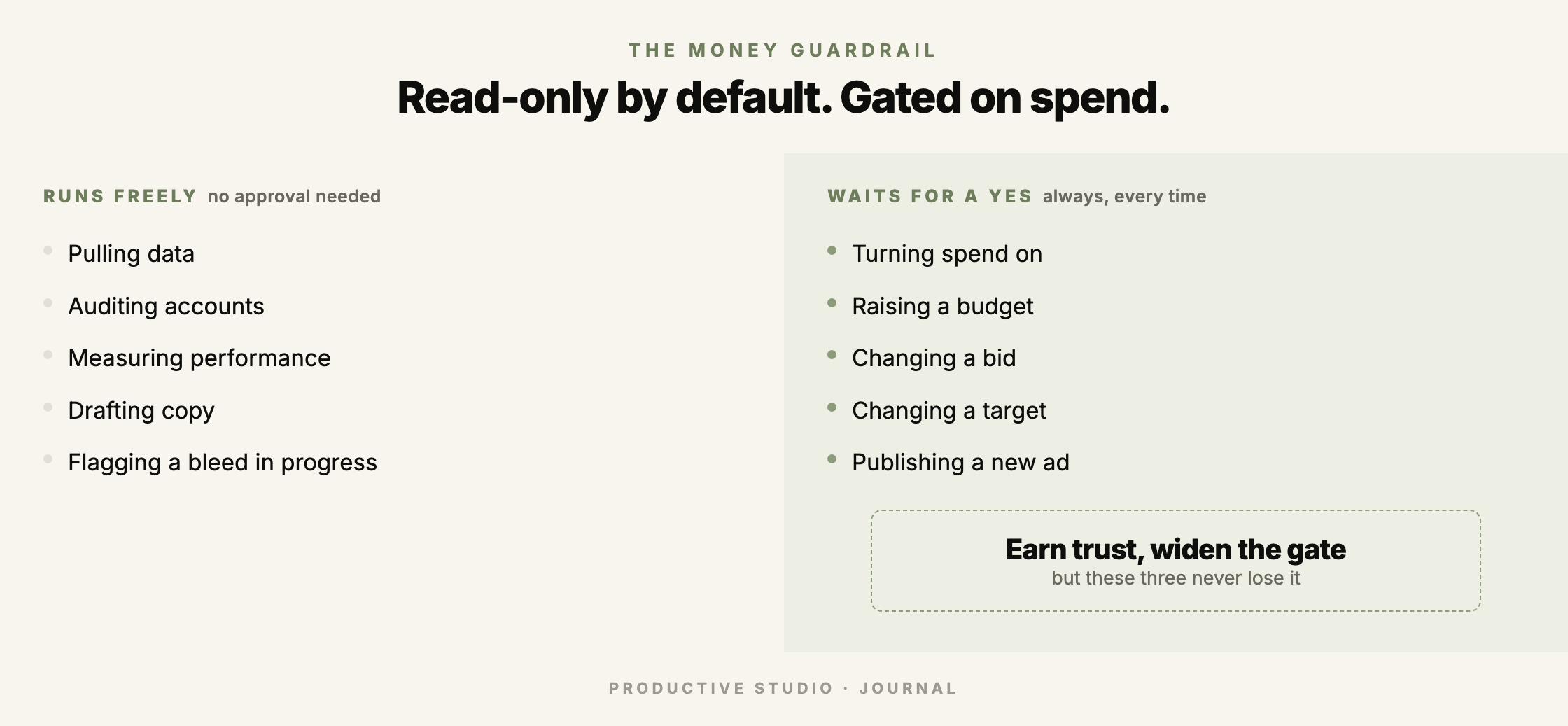
Earn trust, widen the gate, never remove it
The rule isn’t that nothing can ever move without me. That would be unusable, and unusable rules get switched off.
Early on, everything is shown and every yes is waited for. Once I trust a particular kind of move — swapping ad copy inside a budget I’ve already agreed — routine versions of it can run with lighter review. The gate widens as the trust earns it.
But three things never lose the gate, no matter how long it’s been running or how well it’s going: turning spend on, raising a budget, and publishing a new ad. Those always wait for a yes.
I want to be clear that this is not a clever feature. It’s a boring piece of plumbing. Nobody is going to be impressed by it at a dinner party. It exists because seven thousand dollars left my account in a month I had authorised seven days of, and I decided I was not going to rely on everyone downstream of me being careful forever.
 Pairs well with thisEcho — Content & Social OperatorLearns your voice, then drafts the week.
See Echo
The part that isn’t about ads
The reason I’m writing this as a post rather than leaving it as a line in a file is that the principle generalises, and I think most owners have the same hole somewhere else.
Anywhere you’ve handed over access to something that spends money or acts on your behalf — ads, subscriptions, a card on file with a vendor, a tool with a seat count that grows — ask yourself one question. Not do I trust them. You probably do, and it’s not the right question.
Ask: what is the shortest path from someone being busy to my money being gone, and is there a door on it?
If the honest answer is that you’d find out in the next report, you don’t have a gate. You have a receipt.
A human bookkeeper, a human marketer, a human assistant — all of them can hold that line, and good ones do. What changed for me is that I stopped hoping it would be held and wrote it down as the rule that can’t be overridden, including by me, including when I’m in a hurry and would quite like to skip it.
That is the whole lesson from a bad month. Not don’t trust people. Just: put the door in before you need it.
The Big Five Websites, apps, ads, content and video — the five premium operators, together. See the Big Five →