
There was a long stretch where my days ran fifteen hours.
Not the occasional one. Most of them. Up before anyone else in the house, laptop already open, still going at eleven at night, and then the part afterwards where you lie in the dark going through everything you didn’t get to. I was overwhelmed and I was exhausted. There was no time in any of it for exercise or movement — that went first, and I’ll come back to why it always goes first.
But the hours weren’t the part that bothered me.
The part that bothered me was that the needle didn’t move. Fifteen hours a day, and I could not point at one area of any of my businesses that was measurably further along than it had been a month earlier. Everything got touched. Nothing got anywhere. I was doing too much and not moving forward in one area or another, and for a long time I read that as evidence I was doing it wrong.
I wasn’t doing it wrong. I was doing all of it, which is a different problem wearing the same symptoms.
Sponsored · Productive Studio What could your AI be doing while you sleep? Two minutes tells you where you stand — and what to hand over first. Take the quiz →Effort and progress are not the same currency
Here is the thing I wish someone had said to me early.
Every function in a business has a floor. A minimum amount of attention it needs before it does anything other than stay alive. Below that floor you can work on something indefinitely and it will not advance — it will simply not collapse.
Marketing below the floor looks like posting often enough that you haven’t disappeared, and never often enough that anything compounds. Sales below the floor looks like answering the people who happen to find you, and never having a week where you go and find more. Operations below the floor looks like things getting handled at the exact moment they become urgent and not one hour sooner. Finance below the floor looks like knowing roughly where you stand, in the way you roughly know how much gas is in the car.
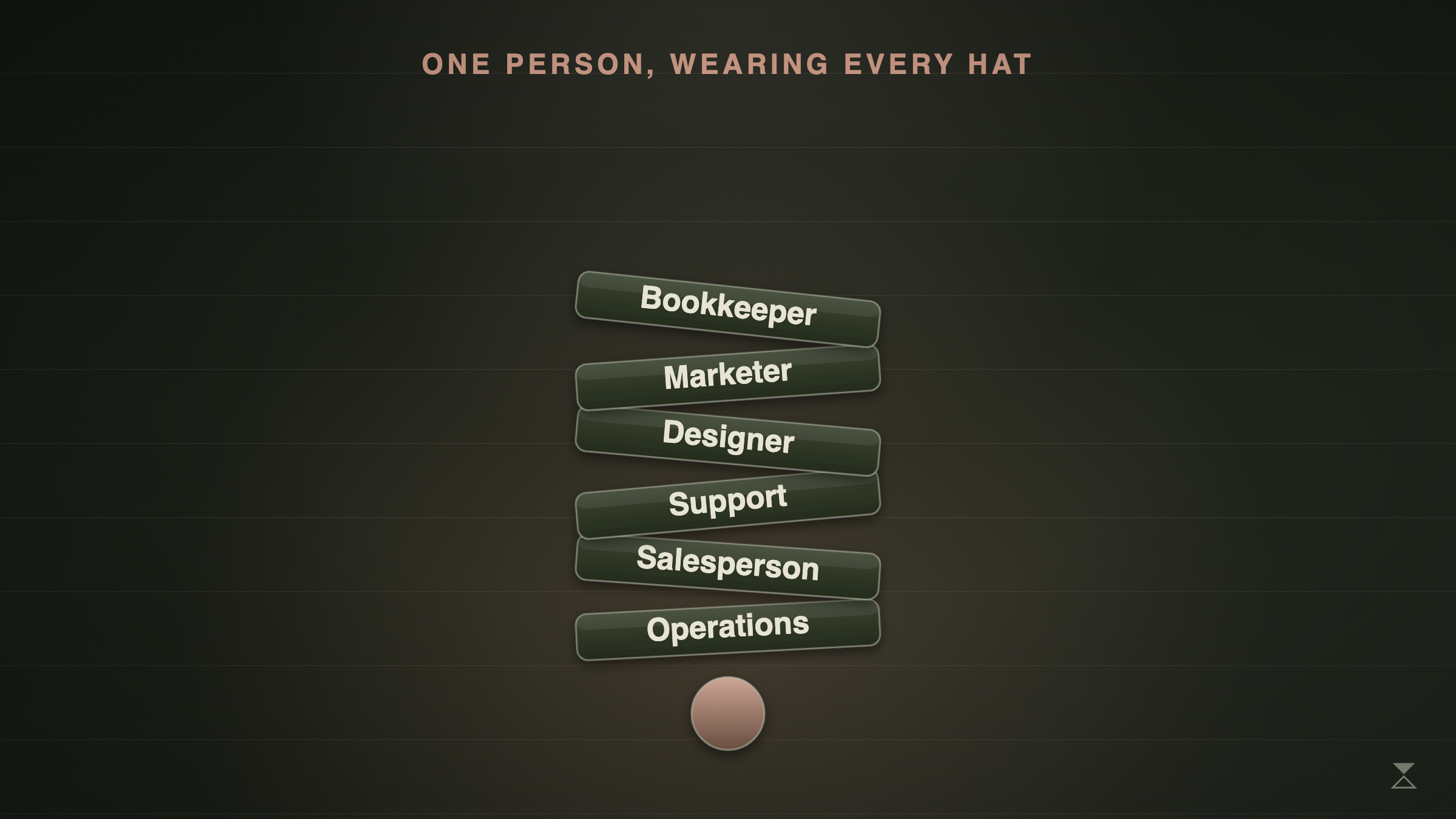
Now count the functions you personally run. Not the ones you’d list on a website. The real count — sales, marketing, content, admin, finance, delivery, support, whatever your version of the list is.
You have one attention. Divide it across every function in the business and each one lands under its floor. So you get maintenance in every direction and progress in none.
That is what fifteen-hour days with a still needle actually are. It isn’t laziness. It isn’t a discipline gap. It’s arithmetic, and the arithmetic doesn’t care how hard you worked.
This is also why “just focus on one thing” never landed for me. Focus advice assumes the other eight functions have somewhere else to be. In a solo business they don’t. Give one function the attention it needs and you can watch the other eight degrade in real time while you do it. So you rotate. And rotating is the thing that keeps everything at the floor.
The first thing that goes
Movement goes first. Every time.
I’ve thought about why, and it isn’t complicated. Every other item competing for that hour has someone attached to it. A client waiting on a reply. An invoice with a date on it. A post that’s meant to go out. A supplier expecting an answer. Somebody, somewhere, notices if it doesn’t happen.
The walk has nobody waiting on it. It is the only line in the day that can be quietly removed without a single person registering the loss. Which is precisely why it’s the first thing cut, and then the twentieth, and then it stops being on the list at all and you don’t remember taking it off.
I’m not going to turn that into a wellness lesson. I’m telling you because it’s the clearest reading I have of how badly the arrangement was set up. When the only item in your day without an external stakeholder is your own body, your body is what ends up funding the business.
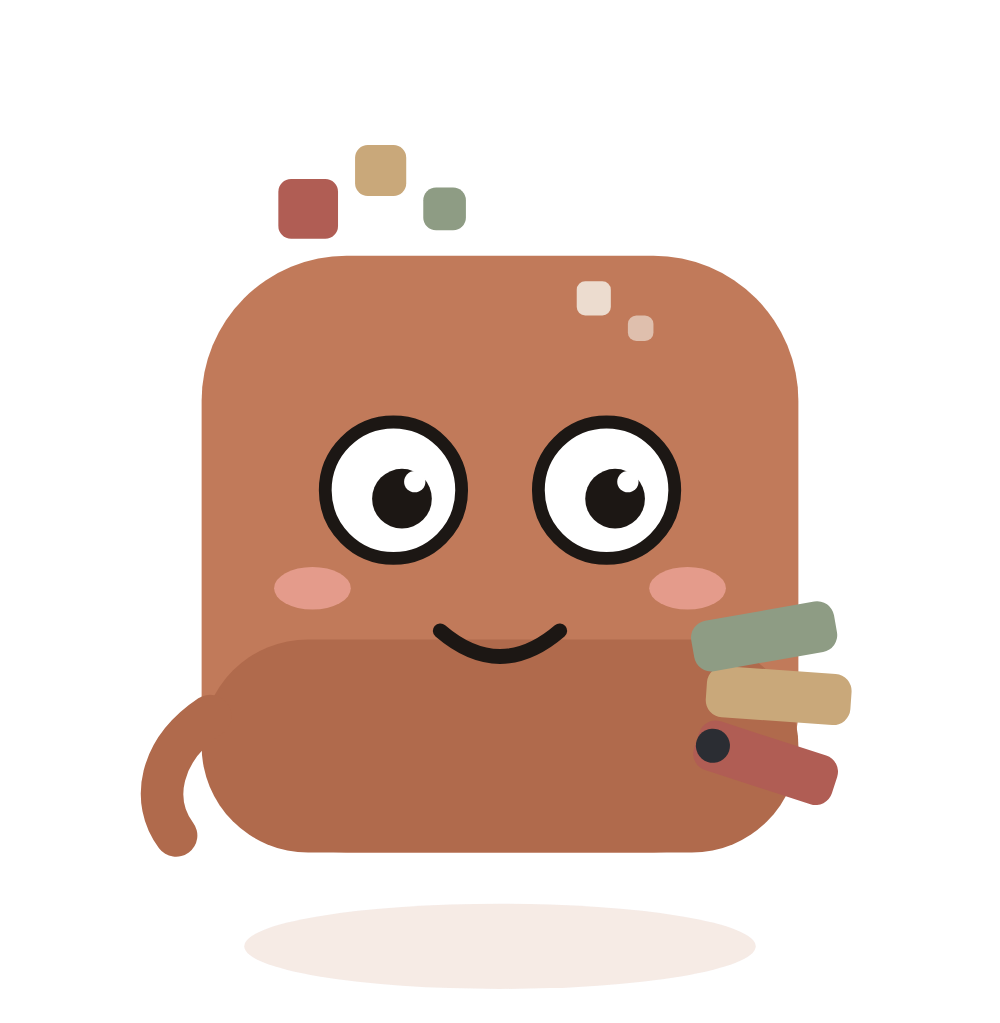 The operator in this postPixel — Visual CreatorBrief it plainly. It holds your brand.
See Pixel
The operator in this postPixel — Visual CreatorBrief it plainly. It holds your brand.
See Pixel
Where the expectation actually came from
Here’s what I think is worth naming, because it’s the part that makes people feel like they’re failing at something everyone else manages.
One person covering every function is not the natural state of running a business. It’s a recent arrangement, and it arrived quietly.
Design software meant you could make the thing yourself. Accounting software meant you could keep the books yourself. Publishing platforms meant you could be the entire marketing department yourself. Every one of those arrived described as something being removed — a cost, a gatekeeper, a dependency. And every one of them was.
What nobody said out loud is that access to a function is not the same as capacity for it. The tool removed the cost and handed you the job. Then it did that eight more times, and the expectation quietly reset around the new arrangement: a capable owner should be able to run every department, because look — all the departments are right there on the screen, and they’re included.
So the feeling that you ought to be able to hold all of it is inherited, not earned. There is no earlier generation of solo owners who ran every function properly and set a standard you’re missing. The standard was never met. It was assumed, by people with a commercial reason to assume it.
You were never supposed to run all of it alone. You were supposed to have somewhere to put it.
Delegation is not the same as hiring
For most of the fifteen months I spent going in circles with AI, I was doing the thing that keeps you exactly where you are: asking for help with tasks.
Help with a task means you still own the function. You still decide when it happens. You still hold every piece of context in your head, you still write the brief, you still chase the follow-through, and you still notice when it hasn’t been done. You’ve added a step to your process. You haven’t put anything down.
Delegation is when a function has an owner who isn’t you.
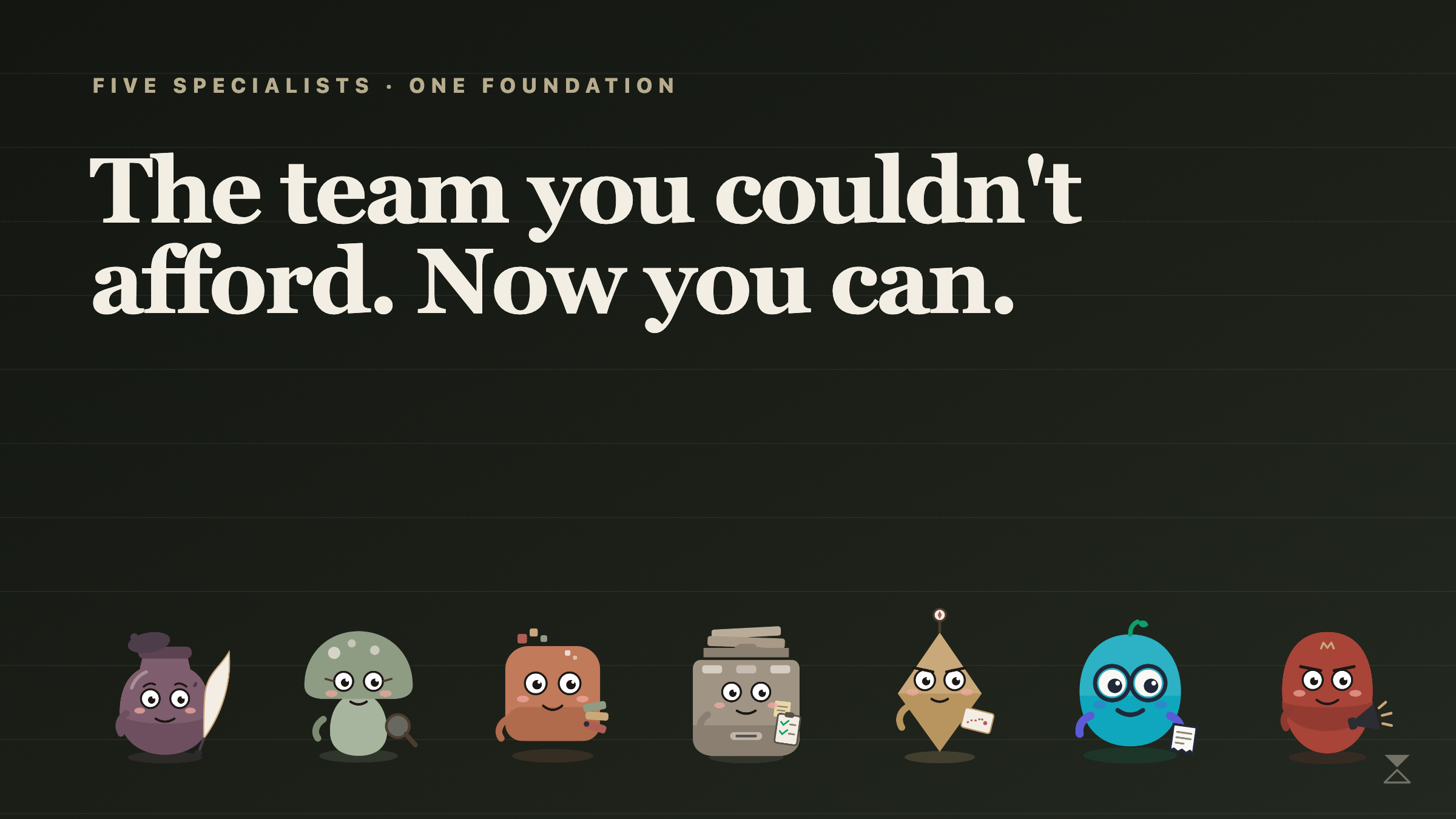
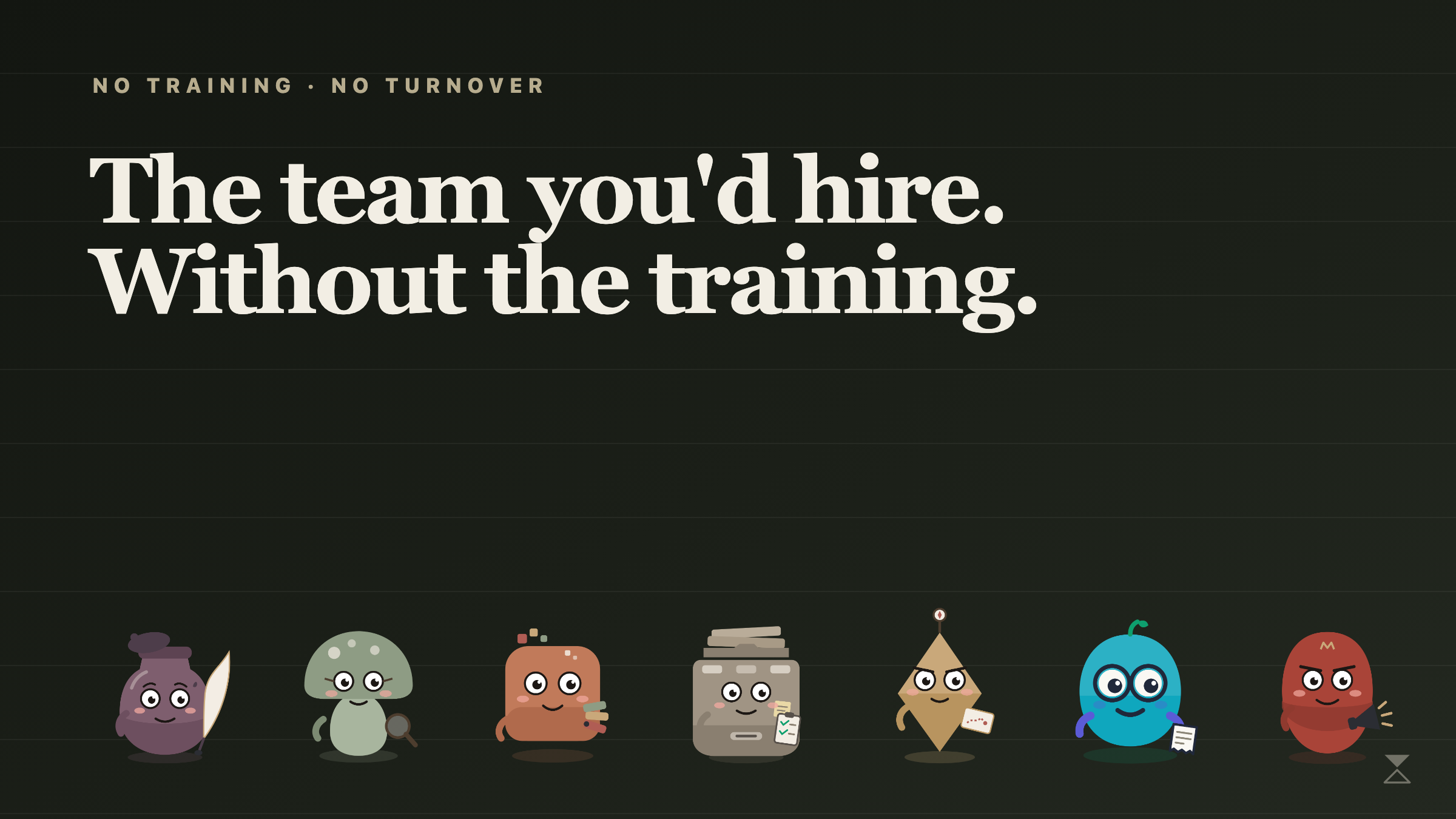
That distinction took me an embarrassingly long time to see, and it’s the whole reason my hours started producing something. I stopped asking for help and started handing over functions — to operators, which is a word I’ve been careful about, and which I’ve explained properly in what a pre-trained operator actually means. The short version: an operator isn’t a tool you drive, it’s a function with an owner, trained on how my businesses actually run rather than how businesses run in general.
Above them there’s Ellestra, my AI COO. I don’t brief specialists one by one — that’s just management with extra steps, and management is the job I was trying to stop doing. I tell her what needs to happen. She decides where it belongs and comes back when there’s something for me to approve.
The other half of it is that the work carries on when I’m not in the room. There’s a scheduled check-in that runs on its own rhythm and tells me what’s pending, what needs attention, and what’s already handled. I don’t prompt it. I don’t remember it. It arrives.
That’s the piece that changes the arithmetic. Not more hours. More owners.
 Pairs well with thisForge — App Builder OperatorValidates the idea, writes the brief, then builds it.
See Forge
Pairs well with thisForge — App Builder OperatorValidates the idea, writes the brief, then builds it.
See Forge
What came back first
I want to be straight about what changed, because the version of this story where everything resolves in a weekend is a story, not a business.
My hours didn’t collapse. Some weeks still run long — I run eight operations and launch weeks are launch weeks.
What changed is that functions started clearing their floor. One at a time, then two, then most of them. Content stopped being maintained and started compounding. Files stopped being a search problem. Research stopped being an afternoon that produced fifteen tabs and no decision. And once several functions were above the floor at the same time, the needle moved on its own, without me finding extra hours anywhere, because the hours I already had stopped being divided every which way.
The other thing that came back is the one with no stakeholder attached.
The dogs.
They were with me the whole time I worked. Every one of those fifteen-hour days, in the room, right there beside me — and not once actually attended to. Present but never given anything. That’s its own quiet cost, and I didn’t see the size of it until it changed.
What came back first was taking them out. A swim. A walk. Nothing more organised than that. The workouts came after, once the walks had been happening long enough that there was something left over to spend on them.
That’s the whole of it, and I’m going to leave it that size. A walk with the dogs is not a transformation. It’s just the first line in the day that came back — the one with nobody waiting on it, the one that had been the only thing in the whole arrangement I was allowed to cut.
Where to start
If your days look like my old ones, the fix isn’t a better planner and it isn’t a harder week. You don’t have a productivity problem. You have a full set of functions and one person, and no amount of personal improvement resolves that.
Start by giving your AI somewhere to actually live — its own space, its own memory, its own understanding of who you are and how your business works. That’s the foundation everything else stands on, and it’s the part most people skip on the way to something more exciting. I wrote about the hardware side of that decision in I gave my AI its own desk.
The AI COO Setup Kit is that foundation, start to finish. The machine, the memory, the boundaries, the check-ins that run without you, and an AI that knows your name, your business, and your priorities before you ask it for anything.
Then hand over the first function. Not the easiest one. The one that’s been sitting at the floor the longest.
~ Elfina
The Big Five Websites, apps, ads, content and video — the five premium operators, together. See the Big Five →