
Our VA disappeared.
Not dramatically. Nobody resigned, there was no argument. Messages stopped being answered and work stopped arriving, in a week when I was counting on both.
When we finally got hold of them, there was a family emergency. They’d be back and available in a week.
It ran to two.
Let me say the fair thing first, because I mean it: family emergencies are real. I’ve had them. If that’s what it was, then that is exactly where they should have been and I’d have told them so.
But sit in my chair for a second. From here, I couldn’t know. That’s the entire problem in one sentence. I couldn’t know whether it was true, I couldn’t plan around it either way, and the whole time I was trying to decide what to believe, the work sat there and the week kept moving.
That’s the thing I couldn’t afford. Not the rate. The not knowing.
Sponsored · Productive Studio What could your AI be doing while you sleep? Two minutes tells you where you stand — and what to hand over first. Take the quiz →What “can’t afford” actually means
I’ve called this post the team you can’t afford, so I should be precise about what I mean, because I don’t mean price.
When owners talk about the help they can’t afford, they almost always mean the number at the bottom of the proposal. That’s the version I’d have given you myself once.
It isn’t the real constraint. The real constraint is that a solo business cannot absorb unreliability. There’s no bench. Nobody slides across when someone vanishes for a fortnight, because the entire redundancy plan is you, at night, doing it yourself on top of everything already on the list.
And reliability doesn’t obey the price tag the way you’d hope it would. The assumption is that you pay more and you get someone dependable. That’s the theory. In my experience it has gone the other way about as often as it’s gone the right way, and paying more mostly bought me a better résumé rather than certainty that the thing would land on Thursday. What you’re actually trying to purchase — this will be there, every time, whatever happened this week — isn’t on the menu at any price.
So the honest version of the exercise was never “what does help cost.” It’s “what happens to me in the week help doesn’t show up.”
The job description problem
There’s a second thing that stops you, and it turns up before you get anywhere near cost.
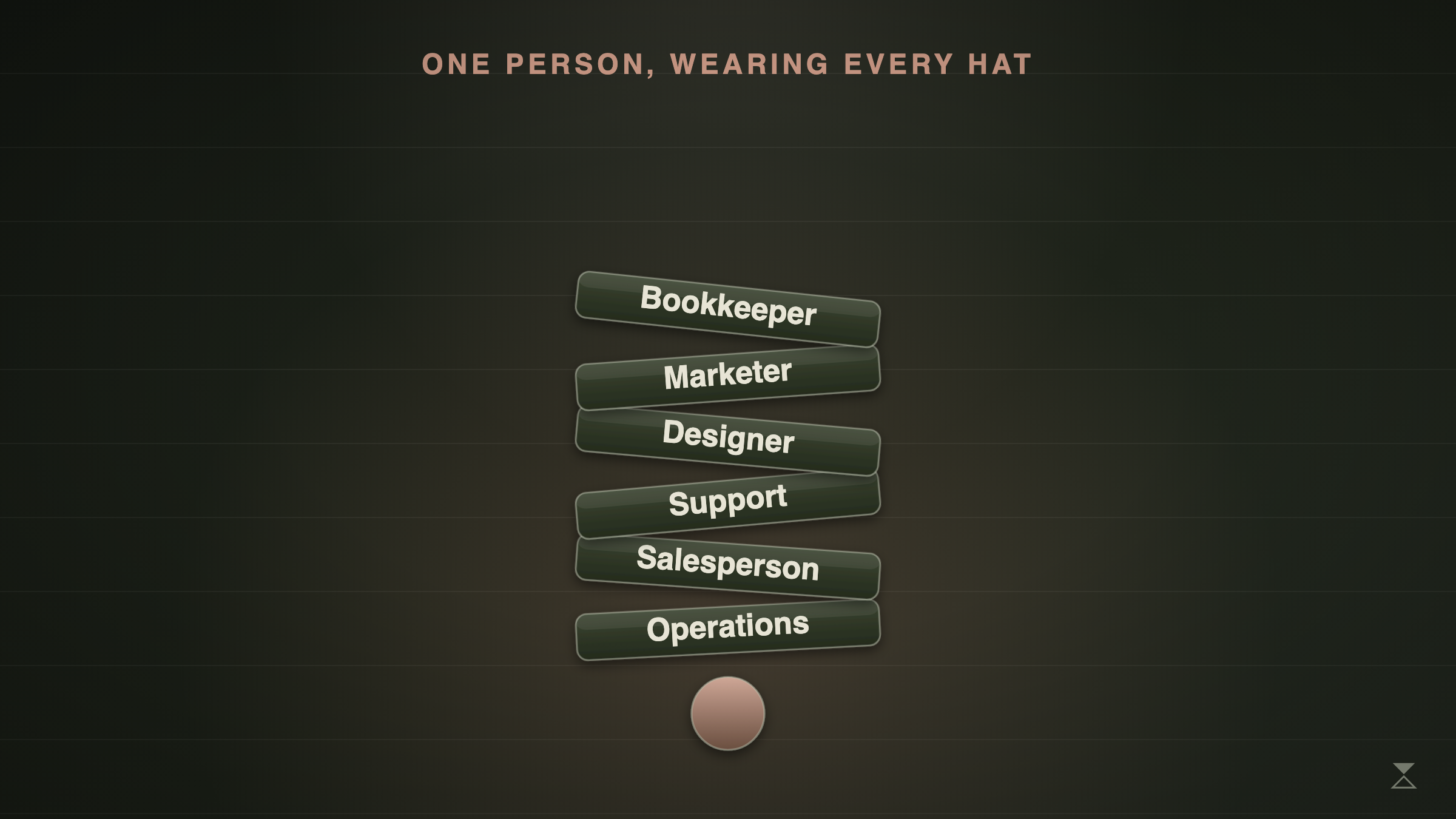
By the time you’ve written the job description honestly — not the tidy version you’d post, the real one — you’re not looking at one job.
You’re looking at five.
Try it. Write down everything you’d hand off tomorrow if you could. No filter, no shame about how small the items are.
Mine came out like this.
Someone to make the visuals. The deck, the pins, the thumbnails, the social images that currently get built at eleven at night in whatever tool happens to already be open.
Someone to map out how things actually work, so a process lives somewhere other than in my head and I can hand it to a person without a forty-minute phone call.
Someone to keep the files in order. Not tidy for the sake of tidy — findable. So “where’s the signed version” stops being a twenty-minute archaeology project.
Someone to do the research. Competitors, vendors, a market I’m considering, a platform I don’t understand yet. The work that eats an afternoon and produces fifteen open tabs and no decision.
Someone to write. Constantly. In my voice, not in the voice AI defaults to.
Five jobs. And here’s the part that ends the exercise: they are five different people.
The person who makes a genuinely good thumbnail is not the person who builds you a filing system that survives contact with a busy week. The person who can research a market properly is rarely the person who writes copy that sounds like you. You know this, because you have tried to find the one who does all five, and what you found was someone who does one of them well and four of them adequately, and adequate is exactly the standard you were trying to escape.
 The operator in this postPixel — Visual CreatorBrief it plainly. It holds your brand.
See Pixel
The shape you can’t buy
A big company hires deep. One function, several people, layers.
A solo business needs the opposite shape. Wide and shallow. A little of five specialisms, none of them full-time, all of them needed this week.
And wide-and-shallow is the most expensive shape of team there is, because breadth means headcount. There is no version of “a fifth of a designer and a fifth of a researcher” available to buy. People don’t come in fifths.
So you compromise, and there are only two ways to do it.
You hire one generalist and accept five jobs done at whatever standard a stretched generalist can hold. Or you hire the one specialist you can most easily justify, and the other four jobs stay exactly where they were — on your desk, at eleven at night.
Neither is a failure of judgment. At your size there genuinely is no third option. It’s arithmetic, not character.
That’s the team you can’t afford. It isn’t out of reach because you’re small. Breadth is the expensive part, and breadth is what a solo business runs on.
And every one of those five positions has the same failure mode as the VA. Five people is five separate chances that somebody goes quiet in the week you needed them, and five separate weeks where you’re sitting there deciding what to believe. Breadth doesn’t just multiply the cost. It multiplies the exposure.
The five I actually run
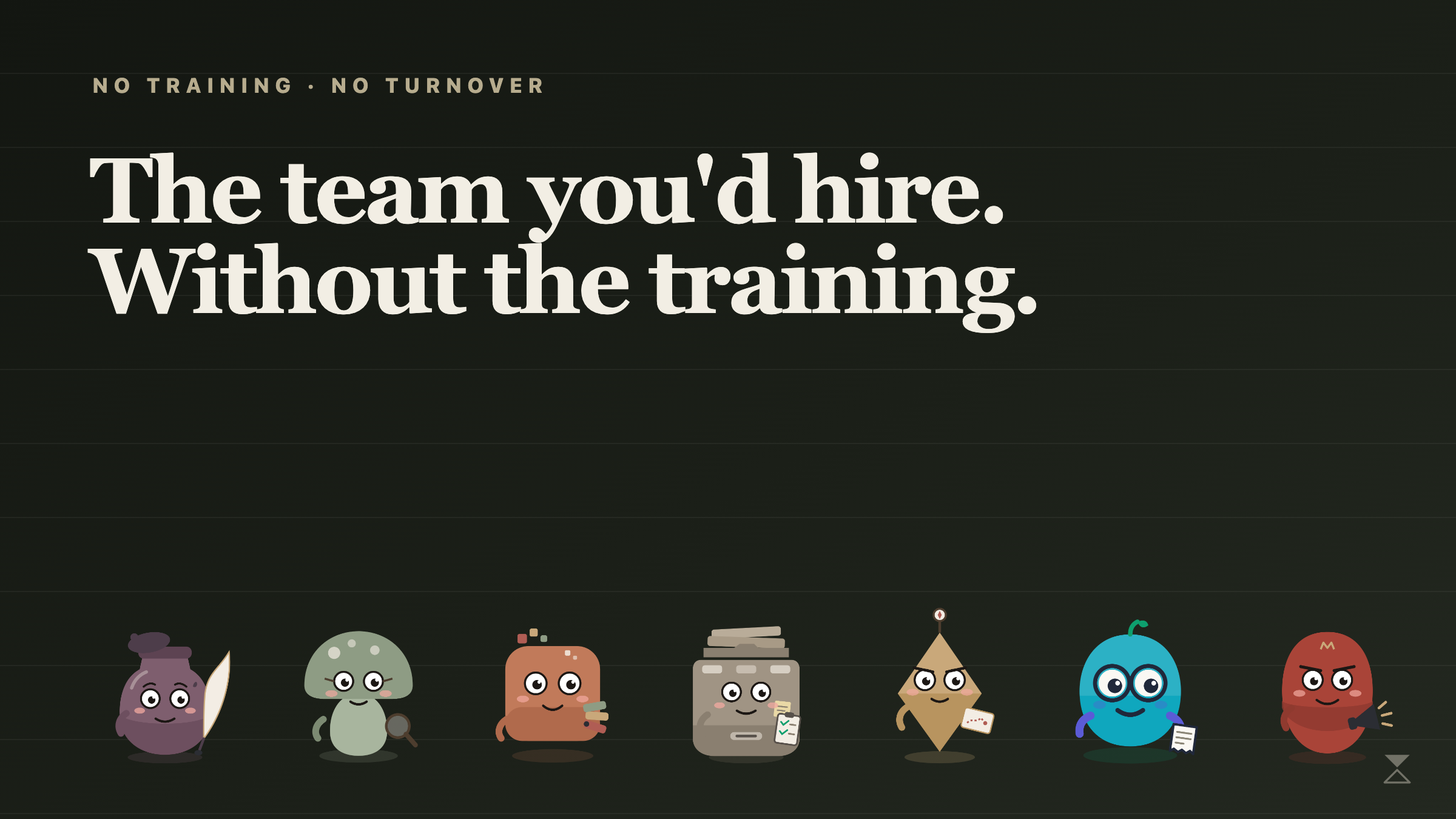
Here is the team I have instead. Five operators, each one built for a single function, each one trained on how my businesses actually work rather than how a business is supposed to work in general.
Pixel is the visual one. Not an image generator — a creative director. Pixel takes a brief, designs the concept, decides which tool the job actually calls for, writes the exact prompt for it, and when the deliverable is a deck or a layout, builds the file directly. Slide decks, Pinterest pins, YouTube thumbnails and course covers, social images at the correct dimensions for the platform they’re going to. The part that used to be eleven at night.
Charter maps things. It builds flowcharts, and it interviews you before it builds — ten questions answered before it draws a single box, because a wrong node is harder to remove than a missing one. What comes out is a single self-contained file that opens in a browser, matched to your actual brand colours, with swim lanes when a process involves more than one person and hidden detail on each step when you click it. This is the operator that gets a process out of your head and onto something you can hand someone.
Atlas handles admin and files. Atlas is not a sorting script. Before it touches anything it runs a preference interview, because the point is to build a system around how you think rather than how a productivity blog thinks. It plans before it moves anything. It never deletes. And it holds an index, so the next session starts where the last one ended instead of starting over.
Sage does research. You give it a question — a market, a competitor, a vendor, a trend — and it returns a structured brief you can act on, not a wall of links. If the brief you give it is vague, it says so and asks you to narrow it before it starts, which is the single most useful habit I’ve built into any operator.
Quill writes. Social, captions, hooks, blogs, email, threads, and the calendar that holds all of it. In your voice, which it learns properly before it writes a word. It drafts, it tracks what’s gone out, and it never publishes anything without your explicit approval.
That’s the five. Design, process, admin, research, content.
Bookkeeping isn’t in that list on purpose — that’s Ledger, and Ledger is his own separate thing with his own separate job. I wrote about how bookkeeping actually got automated across my businesses elsewhere, because it deserves its own explanation.

Nobody manages five of anything
This is the part people miss, and it’s the difference between a team and a toolbox.
I don’t run five operators. I talk to Ellestra.
Ellestra is the COO. She isn’t a task-taker — she doesn’t sit there waiting for me to assign work item by item. I tell her what needs to happen and she decides which operator it belongs to, briefs them, and comes back to me when there’s something to approve.
I don’t open Pixel. I don’t brief Charter. I say the thing, and the thing gets routed.
That distinction matters more than any individual operator does, because managing five specialists is itself a full-time job — the coordinating, the briefing, the remembering who has what. That’s the job most people accidentally give themselves when they buy five AI tools. A toolbox needs someone to operate it, and if you buy a toolbox, that someone is you.
A team needs a manager instead. The manager is the part I stopped doing.
If the word “operator” is doing a lot of work in that paragraph, I explained exactly what I mean by it in what a pre-trained operator actually means — it’s the piece the rest of this depends on.
Where the knowledge lives
One more structural difference, and then I’ll stop.
When you hire a person, the knowledge of how your business runs ends up inside that person. Not because anyone did anything wrong — that’s just where knowledge goes. It sits in their head, in their instincts, in the hundred small judgment calls they learned to make.
With this team, the knowledge was never in a head to begin with. It’s in files. My voice, my clients, my rules, the things I never say, the way I want a deck to look, what a good research brief is. The operators read it. They don’t hold it.
Which means adding a sixth operator isn’t an onboarding event. It reads what’s already written and starts.
I’ve written separately about what that does to the hiring and re-training cycle — this post is about the shape of the team, that one is about the churn. Both things are true and they compound.
What this genuinely doesn’t replace
I’d rather be straight with you than sell you something that doesn’t exist.
None of these five replace a person in a relationship. Client conversations, negotiation, partnerships, the moments where someone needs to feel heard by a human — those are not operator work and pretending otherwise is how people get burned.
What the five replace is the production layer. The making, the sorting, the finding out, the drafting. The work that has to happen for your business to function and that nobody outside your business will ever see.
That’s the layer that has been quietly eating your evenings. It’s also the layer that was never worth a hire on its own — which is exactly why it never got one, and exactly why it’s still yours.
 Pairs well with thisForge — App Builder OperatorValidates the idea, writes the brief, then builds it.
See Forge
What it costs instead
You don’t get out of paying for this. You pay in a different currency.
You pay in specificity. Writing down what you actually want, how you actually sound, what good looks like when you see it. It’s a real cost and it’s the only real one, and it’s front-loaded — you do it at the start rather than every time someone new arrives.
That’s the trade. Not money for people. Clarity for capacity.
And what I get back isn’t loyalty. I’m not going to dress it up as that, because it isn’t that. What I get back is availability. The work happens on the day it’s supposed to happen. If something goes wrong, the thing that went wrong is mine to fix rather than mine to sit and wonder about.
Which is the only definition of affordable I care about now. Not cheaper. Knowable.
Where to start
Don’t start by picking an operator. Start by building the foundation the five stand on — the dedicated space, the memory that carries between days, the context that tells your AI who you are and how your business actually works.
The AI COO Setup Kit is that foundation. It’s the same one running across my eight businesses, and it’s what makes the difference between five impressive demos and an actual team.
Then add the specialists. In whatever order your eleven-at-night list says to.
The Big Five Websites, apps, ads, content and video — the five premium operators, together. See the Big Five →