
7:12am. My eyes have been open for about four seconds and my hand is already on my phone. I’m reading email in bed. Nothing in there is urgent and I know it isn’t, and I read all of it anyway, because if I don’t look I’ll spend the shower wondering what’s in there.
That’s the start of the Wednesday I want to describe to you. Not a bad Wednesday. Not a crisis day. An ordinary one — the kind I had over and over for years while running eight operations and telling myself things would settle down once I got on top of it.
I never got on top of it. I got a system instead. But before the system, here’s what an ordinary Wednesday actually looked like.
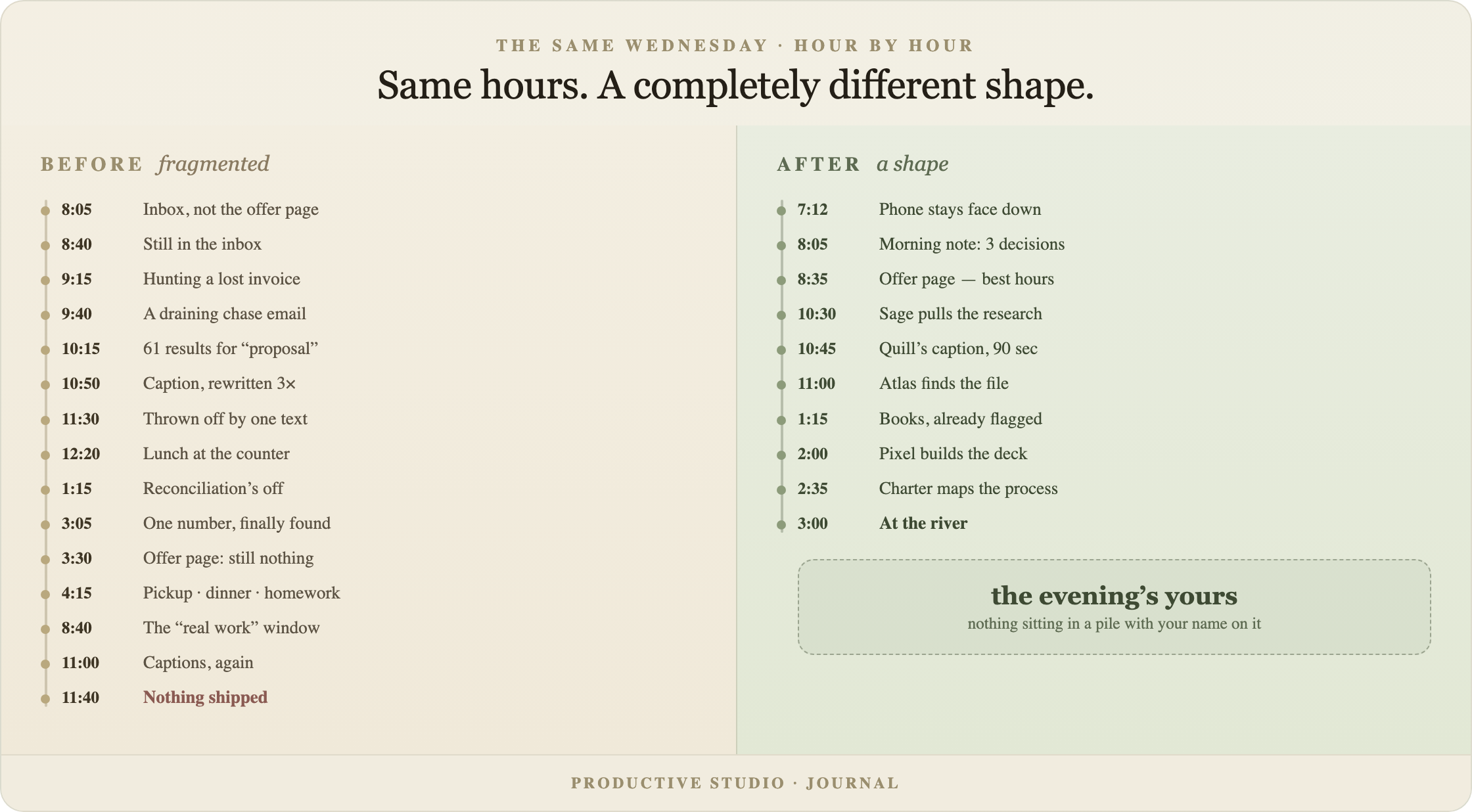
The hours are identical. What changed isn’t discipline, and it isn’t an earlier alarm — it’s what the day is made of.
And that’s just Wednesday. Sunday had its own version — the Substack sitting empty at 9pm while I tried to produce a thought worth publishing on the one evening of the week I had nothing left to think with.
Sponsored · Productive Studio What could your AI be doing while you sleep? Two minutes tells you where you stand — and what to hand over first. Take the quiz →The part nobody warns you about
Here’s what I want to name, because for a long time I misdiagnosed it.
I wasn't busy. I was fragmented.
Busy is a full day of hard work that produces something. Fragmented is a full day of switching — inbox to invoice to file hunt to caption to bank feed to text message — where every switch costs you a few minutes of re-entry, and by 4pm you’ve paid that tax forty times and you’re too tired to do the one thing you’re actually good at.
And the tasks themselves weren’t hard. Not one of them required twenty years of running businesses. Chasing an invoice, renaming a file, rewriting a caption, finding a duplicate transaction — that’s work a competent assistant does. I just never had one, because I was solo, and hiring felt like a bigger project than the work itself.
So the expensive skill in the room — deciding what the business does next — got whatever was left at 8:40pm. Which was nothing.
 The operator in this postQuill — Content ManagerNine kinds of content, written the way you write.
See Quill
The operator in this postQuill — Content ManagerNine kinds of content, written the way you write.
See Quill
What I changed
I’m not going to pretend there was a single moment. There were months of going in circles first.
But the two changes that actually held were these. First, I gave the AI its own machine instead of running it in a tab on the laptop where I do everything else — that story’s here, and it’s the one that made everything after it possible. Second, I stopped asking AI for help with tasks and started giving operators whole functions.
That second one is the difference. Asking for help means you still hold the job. Handing over a function means the job has an owner who isn’t you and who remembers what happened last week. It’s the same shift I wrote about with content and the Sunday night panic — you stop being the bottleneck in a function your business is going to need for the next ten years.
Here’s what that bought back.
By three, I’m at the river
You saw the shape of it up top: by three, I’m at the river. That’s the whole line — I don’t have a productivity insight to attach to it. The day had a shape, it finished, and there’s nothing sitting in a pile with my name on it. Not every Wednesday. But often enough that it’s just what I do now.
And the captions went out days ago, in my voice, at a time of day when I was awake.
What actually changed
I want to be honest about this part, because the internet is full of people telling you they got their life back down to four hours a week.
I don’t work fewer hours every week. Some Wednesdays still run long. Launch weeks are launch weeks.
What changed is where the hours go. The work only I can do — pricing, positioning, deciding what we build next, the client relationships that need my actual face — gets the middle of my day now instead of the dregs of it. The surrounding work still happens. It just doesn’t happen through me.
And the day has a shape again. A beginning, a middle where the real work sits, and an end I can see coming. That’s the thing I didn’t know I was missing. Fragmentation doesn’t feel like overwork while it’s happening. It feels like being mildly behind, all day, forever.
 Pairs well with thisMaven — Marketing OperatorRuns the paid side — behind a gate on every dollar.
See Maven
Pairs well with thisMaven — Marketing OperatorRuns the paid side — behind a gate on every dollar.
See Maven
What to do next
If your Wednesday looks like the first version, the fix isn’t a better to-do app and it isn’t waking up earlier.
Pick the single function that fragments your day the worst. For most people it’s files, content, or the inbox. Give that one away first, properly — one operator, one function, set up once so it remembers.
The AI COO Setup Kit is how I’d start. It walks through the setup that made all of this possible: the machine, the memory, the boundaries, and the first operators — so the thing you build actually keeps running in three months instead of quietly dying in three weeks.
Then go have a Wednesday with a shape to it.
~ Elfina
The Big Five Websites, apps, ads, content and video — the five premium operators, together. See the Big Five →