
I used to like doing my books.
Not tolerate. Like. There was a stretch of years where sitting down with a month of transactions was one of the parts of running a business I actually looked forward to — a task with a clean edge on it, where you start with a mess and end with something true.
I don’t think I’ve ever said that out loud to another business owner without getting a look.
But it’s the honest starting point, and it matters, because what happened next didn’t happen to a task I hated. It happened to one I liked. That’s the part I want to describe properly, because I think a lot of people are living inside the same slide and have quietly concluded it says something about them.
What I liked was the learning. All of it — the whole process of figuring out how the thing worked, why this number sat here and not there, what the books were actually telling me about the business underneath them.
And more than that: I love being a business owner. I love running everything from zero to a hundred and wearing all the hats. That isn’t a line I’m saying to be likeable about it. Doing my own books was part of running the whole thing myself, and running the whole thing myself was the part I wanted. The books came with the territory I’d chosen, and for a long stretch I was glad they did.
So this isn’t a story about a chore that finally caught up with me. It’s a story about something I chose, and enjoyed, going bad in a way I didn’t see coming.
Nothing about the task ever changed
This is the thing that took me longest to understand.
The work I dreaded at the end was the same work I enjoyed at the beginning. Same categories. Same bank feed. Same basic question asked over and over: what was this, and where does it go.
Nothing got harder. No new software. No new rules. Nobody added a step.
The only variable that moved was how much of it was in front of me when I finally sat down.
And that turns out to be enough. Volume alone can take a task you like and turn it into a task you avoid, without changing a single thing about the task itself. I would have told you, before I lived it, that if you enjoy something you enjoy it. That’s not true. There’s a quantity at which enjoyment stops, and it arrives without warning you.
The creep
Here are the actual numbers, because I think they’re smaller than people expect and that’s exactly the point.
About a hundred transactions in a month. That’s the monthly volume on one company — not the busiest one, not an outlier, just a working business doing normal business things.
A hundred is fine. A hundred is an afternoon. If a hundred were the whole story I’d still be doing this happily.
But a hundred a month is only fine if you do it that month. Miss it and it doesn’t stay at a hundred, because next month brings its own hundred and now you’re looking at two. Then three. Then four.
Four hundred is four months of a completely ordinary business, sitting in one pile, waiting for me.
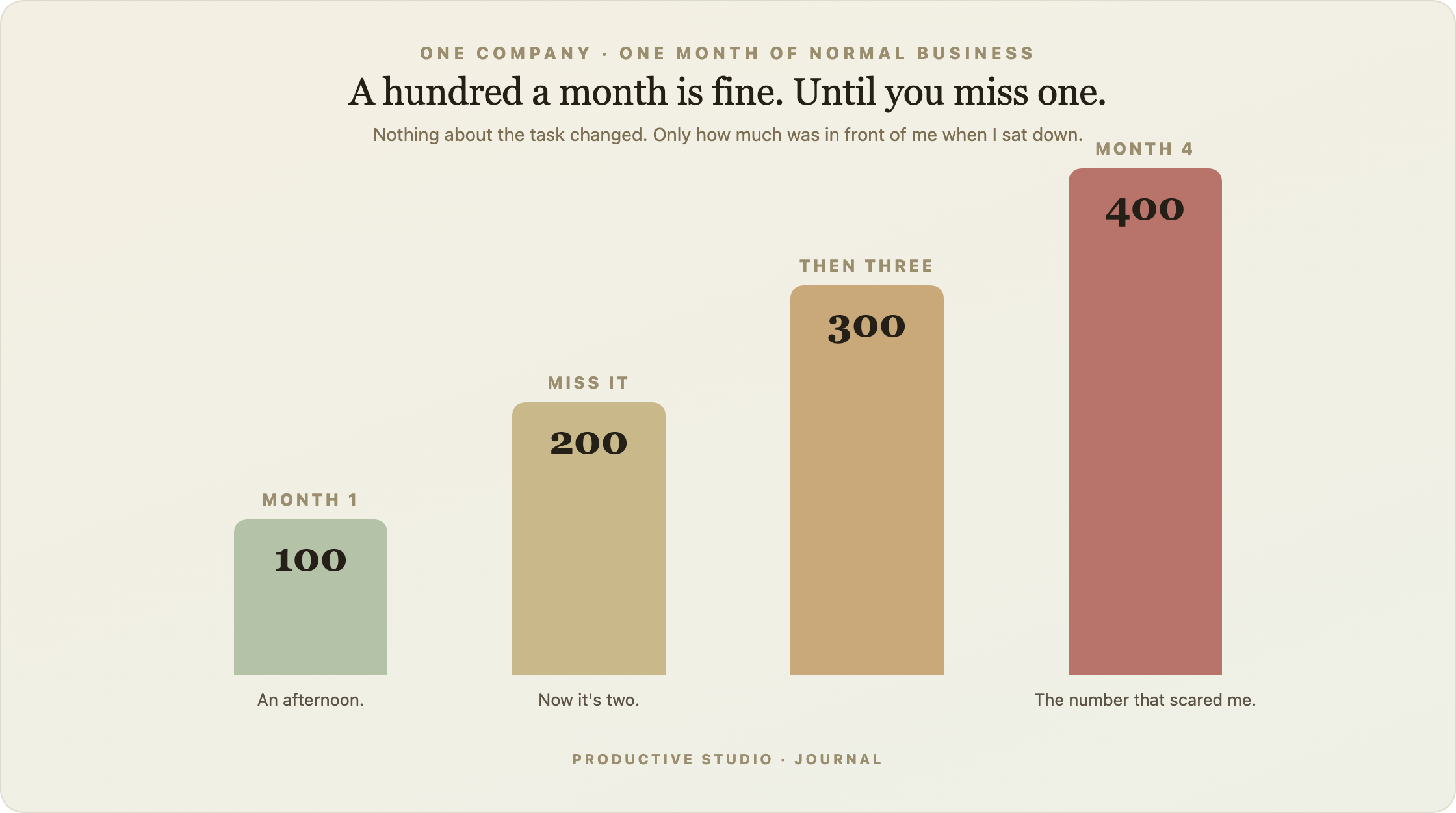
And that was one company. I run eight — but I want to be precise, because the number that broke me was never the total across eight. It was looking at four hundred on a single set of books and doing the arithmetic on what that implied about everything else.
That number scared me. I’ll use the word she deserves: scared. Not “felt like a lot.” Not “was daunting.” I did not want to sit down and go through four hundred transactions looking for receipts and looking for errors, one at a time.
That’s the detail that carries it, and it’s the one people skip when they talk about backlogs as if they were a single object. A backlog isn’t one big thing you deal with once. It’s four hundred small things you deal with individually, and there is no way to do it other than one at a time. Each one wants a receipt found. Each one wants checking for an error you might have made months ago. You can’t batch your way out of it and you can’t skim it, because skimming it is how the errors survive.
Here’s the mechanic underneath that, and it’s the reason volume hits harder than it should.
A transaction isn’t a unit of typing. It’s a unit of deciding. Each one asks you a small question, and you have to answer it with something only you know — which business, which category, whether that supply store run was for the rental or the product side. A hundred small decisions is an afternoon. Four hundred small decisions is not four afternoons. It’s worse than four, because decision fatigue isn’t linear and by the third hour you’re not deciding anymore, you’re guessing and calling it deciding.
Then add being behind. A transaction you handle this week costs one decision. The same transaction four months later costs a decision plus an act of reconstruction — you’re not categorizing anymore, you’re trying to remember a Tuesday. That reconstruction is the expensive part, and it’s the part that grows fastest when you fall behind.
So the pile doesn't just get bigger. Every item in it gets heavier while it sits there.
The date on the calendar
Month-end became a thing I could feel coming.
Not on the day. Before it. There’s a particular kind of low background weight that starts a few days out, where you know what’s waiting and you start pre-negotiating with yourself about when you’ll do it. I’ll do it Sunday. I’ll do it after the quarter settles. I’ll do it when I’ve got a clear run at it.
The clear run never comes, of course. Your busiest stretches are the ones that generate the most transactions and leave you the least capacity to deal with them. So the thing you’re avoiding grows fastest exactly when you’re least able to face it, and every month you defer it, the deferred version is worse than the one you deferred.
That’s when it stopped being a task on a list and became something I was managing emotionally.
When dread turned into something with a physical form
I want to use the accurate word here rather than a softer one.
I started getting anxiety around bookkeeping. Actual anxiety — the kind that doesn’t stay in the hour you’ve allocated for it. It shows up on a Wednesday afternoon when you’re doing something completely unrelated and something in the back of your head reminds you what you haven’t done.
That’s the real cost, and it never appears on any statement. It isn’t the hours. I could find the hours. It’s that a task with no fixed size and no fixed date starts occupying territory in your week that it has no business occupying. You’re paying attention to it constantly and getting no credit for it, because attention paid to avoiding something produces nothing.
For a while I read that as a character verdict. Fifteen years of running businesses and I couldn’t stay on top of my own books. What does that say about me.
It says nothing about you. It says the volume outgrew the method.
Those are completely different findings and people confuse them constantly.”Almost caught up”
People tell me they’re almost caught up.
I never know what to do with that. I don’t really know what it means — almost, on a backlog, isn’t a position, because the same months keep arriving whether or not you’ve dealt with the last ones. You can be genuinely working and still be losing ground, and “almost” is the word people reach for when they want the conversation to move on.
And I understand exactly why they reach for it, because I’ve been the one reaching.
But here’s what I actually think when someone tells me they’re behind, and I want it on the record because it’s the opposite of what they’re bracing for.
I think they're overworked and overwhelmed.
That’s it. That’s the whole diagnosis. Not disorganized. Not undisciplined. Not bad with money or bad at business. Overworked and overwhelmed — which I can say without a shred of judgment, because it’s a description of me for a good stretch of years.
Nobody falls behind on their books because they don’t care. The people I know who are furthest behind are, without exception, the ones doing the most. They’re behind because everything else in the business is louder, and because bookkeeping is the one task with no client on the other end of it waiting to be disappointed.
The shame is the part that keeps it stuck. I wrote about that separately, about the drawer nobody wants to hand over, because the shame does more damage than the backlog does. A backlog is just work. Shame is what stops you from letting anyone near it.
Fifteen years of the same problems
Here’s what actually wore me down, and it wasn’t the transactions.
It was running into the same problems for fifteen years and never finding the right solution to them. Not for lack of looking — I looked. I tried the software, I tried the systems, I tried being more disciplined about it, I tried paying someone. Every one of those solved a piece and left the shape of the problem intact.
That’s a specific kind of tiring that has nothing to do with the work itself. You can enjoy a task for a long time. What you can’t do forever is keep meeting the same wall and keep being told it’s a wall everyone lives with.
So when I say the enjoyment went, I don’t mean I stopped liking books. I mean I got tired of a problem I couldn’t solve.
That’s where Ledger came from
I didn’t set out to build a bookkeeping app. I set out to stop dreading month-end.
The thing I wanted was narrow and specific: I wanted the volume to stop being my problem, and I wanted the decisions that genuinely need me to still come to me. Because that was the part I liked. That was always the part I liked. Not the sorting — the knowing. Sitting with a finished month and understanding what actually happened in the business.
The sorting is what buried it. So Ledger is what I built to take the sorting.
It sits where the monthly bookkeeper used to sit, and it’s built for the mess as it actually exists rather than the tidy version you keep meaning to produce first. Not because tidy is bad. Because waiting until you’re tidy is exactly how another quarter goes by.
If you’re the person I was
The task you’re avoiding is not too hard for you. You already know how to do it — you’ve done it. It’s just that there’s more of it in front of you than there was, and the method you’re using was built for the smaller version.
That’s a solvable problem, and it’s a much less shameful one than the story you’ve probably been telling yourself.
You don’t need a better weekend. You need the volume to stop being the thing standing between you and your own numbers.
And I want to end on the part I actually believe, because I don’t think this is a sad story.
I think we’re at the point where the technology finally lets us solve the things that stayed unsolved for fifteen years. Not work around them. Solve them. The problems I hit over and over weren’t unsolvable — the tools just weren’t there yet, and now they are.
That’s why I built this instead of hiring my way out of it. And I’d happily do my own books again, because it was never the books I stopped liking.
See what Ledger does with the months you’re behind on. Bring it as it is. That’s what it’s for.